AI Trends to Watch: What’s Hot in 2026
Jan 20, 2026
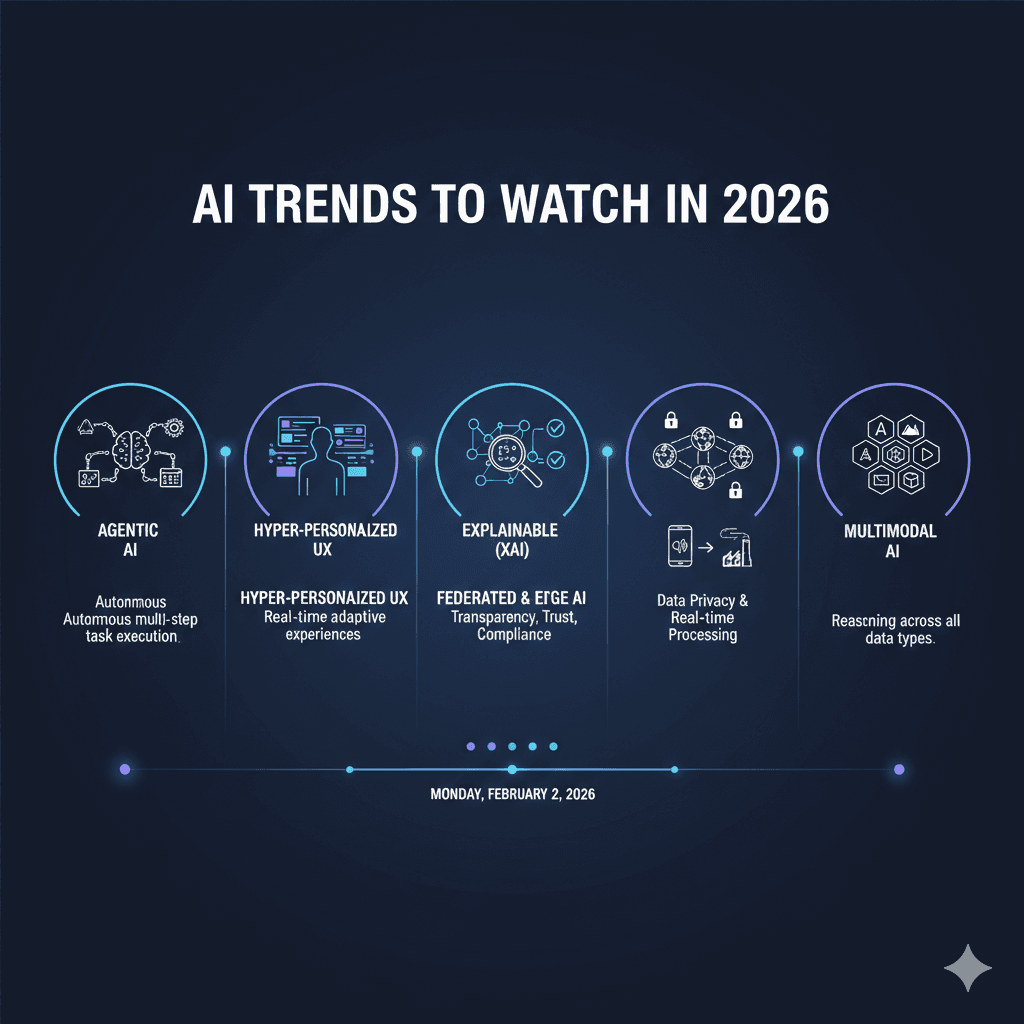
AI Trends to Watch: What’s Hot in 2026
The year 2026 marks a significant shift in the artificial intelligence landscape. We're moving beyond the initial hype of generative AI and witnessing its deeper integration into enterprise operations and everyday life. The focus is no longer just on what AI can do, but what it does effectively and ethically.
Here are the top AI trends to watch in 2026:
1. The Rise of Agentic AI Systems
Forget chatbots that just answer questions; Agentic AI is the new frontier. These systems can take a high-level instruction, break it down into sub-tasks, execute those tasks autonomously, and even learn from failures. Think of an AI that not only drafts an email but also researches the recipient, finds relevant attachments, schedules the meeting, and follows up – all with minimal human oversight.
Impact: This will revolutionize workflows in customer service, project management, and data analysis by taking on multi-step processes end-to-end.
Key Players: Expect to see more advanced frameworks from Google DeepMind, OpenAI, and specialized startups focusing on particular agentic applications.
2. Hyper-Personalized & Adaptive User Experiences
AI is getting even smarter about you. In 2026, AI-powered systems are moving beyond basic recommendations to create truly hyper-personalized experiences that adapt in real-time. This includes:
Dynamic Content Generation: Websites and apps will generate content, interfaces, and even entire user journeys tailored to individual user behavior, preferences, and emotional states.
Context-Aware Interactions: AI assistants will understand not just your immediate request, but also your historical interactions, current location, calendar, and even physiological data (e.g., from wearables) to provide proactive and highly relevant assistance.
3. Explainable AI (XAI) for Trust and Compliance
As AI systems become more powerful and autonomous, the demand for transparency is skyrocketing. Explainable AI (XAI) is no longer a niche research area but a critical requirement for enterprise adoption and regulatory compliance. Businesses need to understand why an AI made a particular decision, especially in high-stakes domains like finance, healthcare, and legal.
Focus: Development of tools and methodologies to interpret complex black-box models, providing human-understandable insights into their reasoning.
Drivers: Increased regulatory scrutiny (e.g., EU AI Act, evolving data privacy laws) and the need for accountability in AI-driven decisions.
4. Federated Learning & Edge AI for Privacy and Efficiency
The push for data privacy and real-time processing is driving the adoption of Federated Learning and Edge AI.
Federated Learning: Allows AI models to be trained on decentralized data residing on local devices (e.g., smartphones, hospital servers) without the data ever leaving its source. This significantly enhances privacy.
Edge AI: AI processing moves from distant cloud servers to "the edge" of the network – directly on devices or local gateways. This reduces latency, saves bandwidth, and enables real-time decision-making in environments like smart factories, autonomous vehicles, and IoT devices.
5. Multimodal AI Beyond Text and Images
While text-to-image and text-to-video gained traction, 2026 is seeing Multimodal AI evolve to truly integrate and reason across diverse data types simultaneously. This means AI systems that can:
Understand and generate content combining text, images, audio, video, 3D models, and even sensory data.
Perform complex reasoning tasks that require interpreting information from multiple senses, mimicking human cognitive processes more closely.
Applications: Enhanced robotics, advanced virtual and augmented reality experiences, and more intuitive human-computer interfaces.
Visualizing the Future of AI:
Here's an image summarizing some of these key trends: