Breaking Down AI Hype - Understanding What AI Truly Is (and Isn't)
Feb 16, 2026
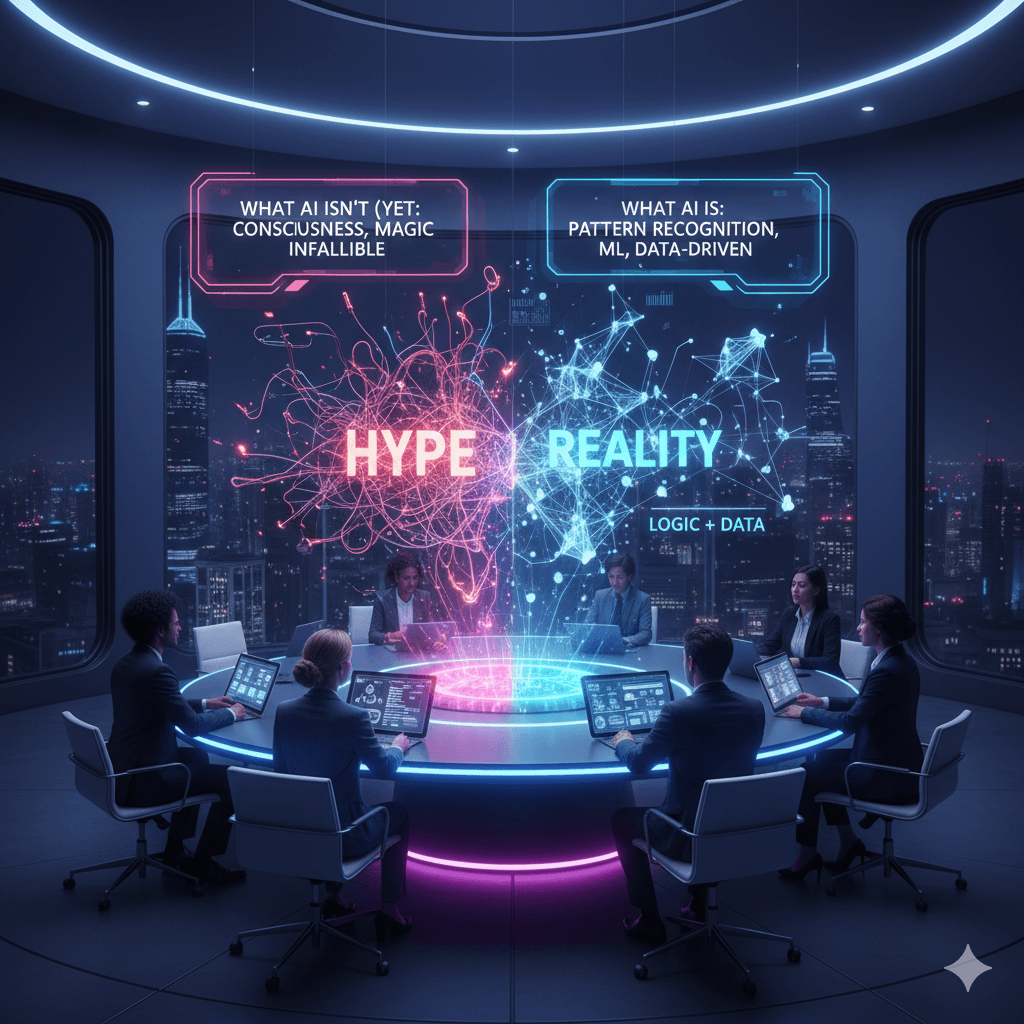
Hello, truth-seekers! In the whirlwind of AI news, breakthroughs, and sometimes sensationalized headlines, it's easy to get caught up in the hype. Today, I want to take a step back and discuss something fundamental: clarifying what Artificial Intelligence truly is, and just as importantly, what it isn't.
Often, AI is depicted in popular culture as sentient robots with human-like consciousness, capable of complex emotions and independent thought. While this makes for great science fiction, it's crucial to distinguish it from the reality of AI today.
What AI Is (in its current form):
Advanced Pattern Recognition: At its core, modern AI excels at identifying patterns in vast datasets. This is what allows it to recognize faces, understand speech, recommend products, or detect anomalies.
Machine Learning (ML): A subset of AI, ML enables systems to learn from data without being explicitly programmed. This "learning" allows them to improve their performance on specific tasks over time.
Problem-Solving Within Defined Parameters: AI systems are designed to solve particular problems or perform specific tasks. Think of them as highly specialized tools, exceptional at what they're built for.
Data-Driven Decision Making: AI processes information and makes decisions or predictions based on algorithms derived from the data it has been trained on.
Augmentation and Automation: Its primary role today is to automate repetitive tasks, augment human capabilities, and provide insights that would be impossible for humans to discover alone.
What AI Isn't (yet):
General Human-Level Intelligence (AGI): We are far from achieving Artificial General Intelligence – AI that can understand, learn, and apply intelligence across a wide range of tasks at a human cognitive level, akin to human common sense and reasoning.
Consciousness or Sentience: Current AI systems do not possess consciousness, emotions, self-awareness, or the ability to experience the world like humans do. Their "understanding" is statistical, not experiential.
Infallible: AI systems are only as good as the data they are trained on and the algorithms they employ. They can inherit biases, make mistakes, and are subject to limitations.
Magic: While the results can seem magical, AI operates on logic, mathematics, and algorithms. There's no inherent "magic" involved, just highly sophisticated computation.
By understanding these distinctions, we can engage with AI more realistically, critically, and effectively. It allows us to appreciate its immense potential without falling prey to unrealistic expectations or unnecessary fears. Let's focus on building AI that is intelligent, useful, and responsibly integrated into our world.
What's one common AI misconception you'd like to debunk? Share it in the comments!
Stay informed, Your AI Expert